
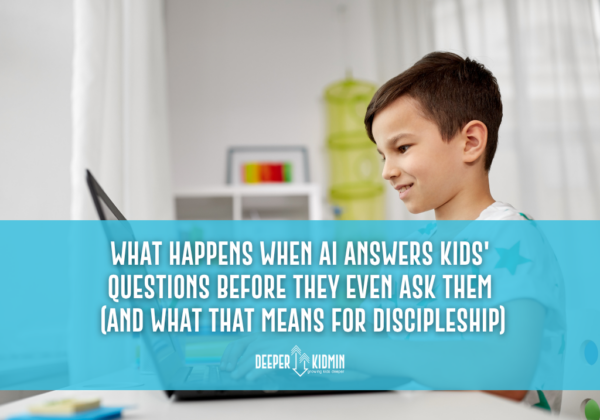
A kid types “who created the world” into Google. Before they finish the sentence, AI produces a full paragraph. They read it, close the tab, move on. Question answered. Wonder never started.
Common Sense Media just rated Google’s AI search features as an “unacceptable risk” for children, and 75% of U.S. teens and tweens are already using it. It can’t be turned off even with SafeSearch on, and it answers with equal confidence whether it’s right or wrong.
The content concerns are real. But the discipleship concern underneath them is the one ministry leaders need to sit with.
In the four Gospels, Jesus gets asked a question 187 times, and do you know how many he directly answers? Three. In contrast, Jesus is recorded as asking over 300 questions. Jesus didn’t just answer questions automatically; instead, He asked questions to engage people’s curiosity, minds, and faith. “Who do you say that I am?” (Matthew 16:15). The disciples had to wrestle with who Jesus was and process his death and resurrection over many days. After telling the parable of the Good Samaritan, Jesus didn’t explain the moral. He asked: “Which of these three do you think was a neighbor?” (Luke 10:36). And when a paralyzed man lay by the pool of Bethesda, Jesus looked at him and asked, “Do you want to get well?” (John 5:6). A seemingly silly question with an obvious answer, but the question required the man to engage, to want something, to participate in what came next.
When curiosity always gets an instant answer, it gets lazy. A faith that’s never had to sit with a question doesn’t have roots deep enough for the hard seasons, and biblical imagination gets lost. AI is very good at giving kids answers, but it cannot give them a faith that’s been questioned, tested, and solidified.
So what does this mean for discipleship?
- Ask more questions than you answer. When a kid asks something big, resist the urge to fill the silence immediately. “What do you think?” is discipleship, not a cop-out. You can also be more intentional with asking questions while teaching (here are some of our favorites).
- Be OK with saying “I don’t know.” It’s important for kids to learn that faith requires some element of trust without complete understanding and that we won’t always have a definitive answer to every question. Isn’t that the definition of faith anyway? Hebrews 11:1 reminds us: faith is “confidence in what we hope for and assurance about what we do not see” (NIV).
- Use technology to deepen wonder, not skip it. This is the core of digital discipleship: the mission stays the same, the methods adapt. Use the screen to open a question, then be the person who walks through it with them.
- Loop parents in. Most are navigating this at home without a framework. A short note about sitting with questions in faith is the kind of beyond-Sunday connection that actually sticks.
The goal has never been kids who know all the right answers. The goal is kids who know who to bring their questions to. In a world that answers before they finish asking, we get to offer kids the opportunity to wonder, question, and discover that sometimes there is no answer this side of heaven, and that’s OK.

Leave a comment
You must be logged in to post a comment.